
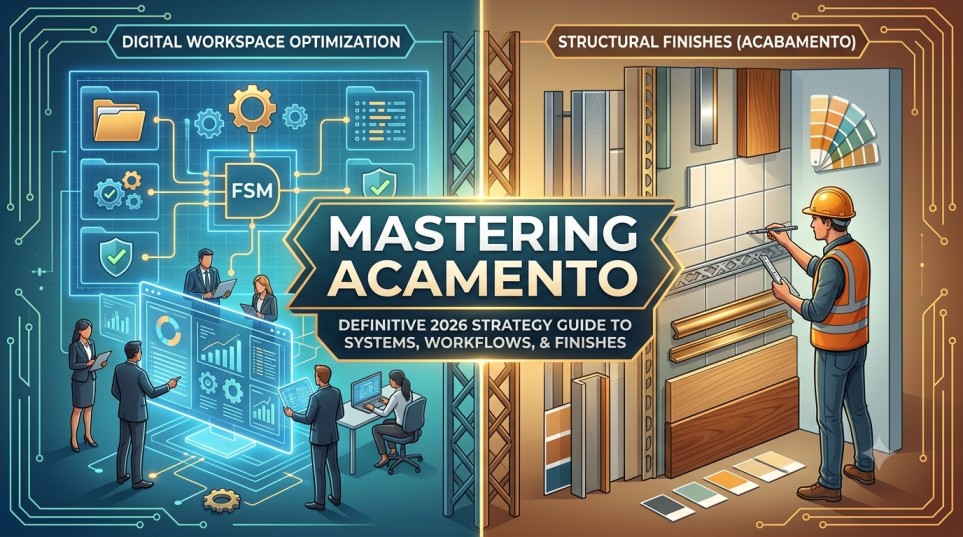
An Acamento Workflow is a structural methodology used to execute the final, precision-oriented phase of a project whether calibrating data states in a digital product workspace or applying physical surface finishes (acabamento) in civil engineering. At its core, the process relies on a Finite State Machine (FSM) architecture to transition an initial layout through a series of strict, conditioned quality gates until it reaches a verified, production-ready state.
Decoding Acamento: What It Is and Why It Matters
The term “acamento” serves a dual role in modern industrial and digital design. In digital workspace optimization, it refers to the systematic logic used to structure files, automate permissions, and connect disparate APIs into a singular, clean operating environment. Conversely, in international trade and regional supply chains, the term frequently appears as a common linguistic variant or search misspelling of the Portuguese acabamento which dictates the final surface treatments, trims, and architectural finishes in commercial construction.
Understanding this distinction is critical for project managers. Whether you are finalizing a software interface or managing a real estate development project, the acamento phase governs the entire user experience. It shifts a project from a purely functional, raw state into a polished, high-performance asset. Failing to optimize this phase leads directly to structural inefficiencies, lower asset valuation, and immediate user friction.
Technical Blueprint: The FSM Architecture of an Acamento Workspace
Digital acamento platforms manage complex operational environments by utilizing a Finite State Machine (FSM) data logic. This mathematical model stipulates that a system can only exist in one defined state at any given moment. When a user initializes a workspace or integrates external data streams, the information enters a highly controlled pipeline where state transitions occur only when explicit, pre-programmed conditions are met.
Data Architecture Rule: A piece of data cannot bypass a quality checkpoint. If an asset is marked as “Raw Input,” it cannot transition to “Finalized Output” without satisfying the intermediate validation scripts governed by the system’s conditioned links.
This FSM model eliminates the unpredictability found in traditional, ad-hoc digital folders. By mapping every single operational state from initial ingestion to final archive teams can establish precise automation rules. This level of algorithmic control ensures that system integrations remain stable, security protocols stay intact, and data silos are systematically dismantled.
The Step-by-Step Acamento Execution Framework
Executing an acamento workflow requires strict adherence to a four-stage sequential process. Deviating from this order introduces compounding technical debt or physical structural alignment errors.
Step 1: Workspace Initialization and Tool Integration
Define your environment’s baseline boundaries by segmenting your user base into distinct tiers (e.g., Freelancers, Developers, or Enterprise Administrators). During this stage, establish your primary API webhooks and connect core collaboration tools to ensure seamless data flow into the central hub.
Step 2: Structural Material Prep and Precision Measurement
Whether configuring layout constraints in a UI design file or preparing concrete substrates for physical finishing layers, you must establish exact dimensional tolerances. Measure surface areas down to the pixel or millimeter, ensuring the foundational layer can support the weight of the final overlay materials.
Step 3: State Condition Mapping and Automation Rules
Program the conditional logic that dictates how assets move through your workspace. Construct explicit “If/Then” parameters within your FSM engine, ensuring that automated notifications, approval requests, and status changes trigger instantaneously when an asset hits its target milestone.
Step 4: Quality Inspection and Surface Level Calibration
Conduct a rigorous audit of the completed workflow or physical installation to ensure strict compliance with global quality management frameworks. Any variation that falls outside your predetermined tolerances must be sent back to Step 2 for immediate remediation before public deployment.
Project Costing and Production Timelines
Project budgets and operational timelines scale based heavily on the complexity of your deployment and the quality tier of your chosen materials. The following table breaks down real-world financial allocations and time horizons for standard vs. enterprise-level projects in 2026.
| Project Tier | Financial Allocation (USD) | Operational Time Horizon | Complexity Rating | Automation Potential |
| Standard Tier | $1,500 – $3,500 | 12 – 24 Working Hours | Low to Moderate | Up to 45% of workflows |
| Premium / Enterprise Tier | $8,500 – $25,000+ | 60 – 120 Working Hours | High (Multi-system integration) | Up to 85% of workflows |
For standard projects, expenses are concentrated on basic software seat licenses and fundamental component materials. Enterprise-tier allocations account for custom API development, advanced industrial sealants or hardware finishes, and dedicated engineering oversight to guarantee cross-system stability.
Maintaining Quality and Preventing Technical Debt
Long-term project viability requires absolute compliance with the ISO 9001:2015 quality management standard established by the International Organization for Standardization. This framework dictates that companies must implement consistent, repeatable measurement processes to ensure final outputs match initial specifications.
[Raw Asset/Material Ingestion]
               │
               ▼
[FSM Condition Validation] ──(Fails Quality Gate)──► [Immediate Refactoring/Repair]
               │                                                 │
       (Passes Quality Gate)                                     │
               │                                                 ▼
               ▼                                      [Re-Entry to Validation]
[ISO 9001:2015 Compliance Sign-off]
To combat physical material degradation and digital technical debt, engineering and facilities teams must deploy proactive refactoring schedules. In digital systems, this involves updating outdated code libraries and auditing API connections. In physical spaces, it requires measuring surface wear using the Gloss Retention Index to track degradation before structural failure occurs.
Furthermore, integrating modern 2026 AI layout engines allows teams to automate these inspections. These machine-learning models constantly monitor active systems, identifying anomalies, predicting wear, and automatically optimizing space layouts in real time.
Frequently Asked Questions (FAQ)
Is Acamento free to use for personal projects?
Basic personal tiers for digital acamento workspace tools are generally free, but they limit user collaboration and API integrations. Advanced features, automated FSM logic, and enterprise-grade security protocols require a paid monthly subscription.
What is the difference between Acamento and Acabamento in construction?
“Acamento” is a frequent typographical variant or regional search abbreviation for “acabamento,” which translates to English as the finishing phase of construction. In industrial workflows, acabamento specifically governs surface aesthetics, protective coatings, and final hardware trim installations.
Can I run Acamento workflows natively on mobile devices?
Yes, modern digital acamento environments are fully responsive and support native iOS and Android synchronization. However, complex administrative tasks, such as initial FSM state configuration and deep API mapping, should be executed on a desktop browser for full interface functionality.
How does the system ensure data security for sensitive enterprise operations?
Enterprise workflows secure data by enforcing end-to-end AES-256 encryption for all data at rest and in transit. Additionally, the system integrates directly with identity providers via SAML Single Sign-On (SSO) to enforce strict, role-based access control across all active workspaces.